
Showing posts with label #fhaloans #valencia. Show all posts
Showing posts with label #fhaloans #valencia. Show all posts
Tuesday, February 9, 2016
Groundhog? No groundhog? Why You Should Sell Before Spring

Tuesday, January 12, 2016
*When Is A Good Time To Rent??? NOT NOW!*
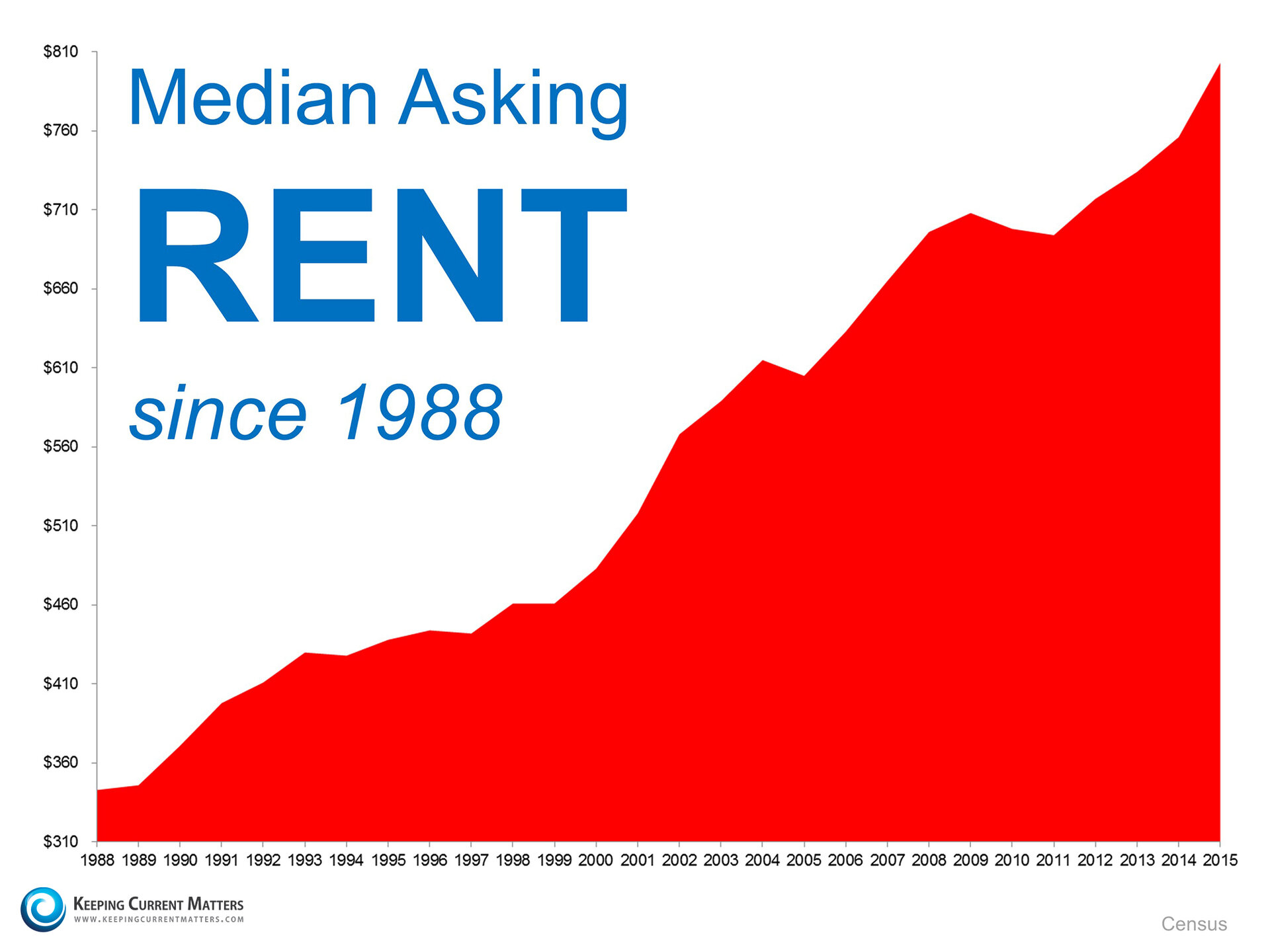 People often ask whether or not now is a good time to buy a home. No one ever asks when a good time to rent is. However, I want to make certain that everyone understands that today is NOT a good time to rent. The Census Bureau recently released their third quarter median rent numbers. Here is a graph showing rent increases from 1988 until today: A recent Wall Street Journal article reports that rents rose “faster last year than at any time since 2007, a boon for landlords but one that has stoked concerns about housing affordability for renters.” The article also cited results from a recent Reis Inc report which revealed that average effective rents rose 4.6% in 2015, the biggest gain since before the recession. Over the past 15 years, rents have risen at a rate of 2.7% annually.
Where are rents headed?
Jonathan Smoke, Chief Economist at realtor.com recently warned that:“Low rental vacancies and a lack of new rental construction are pushing up rents, and we expect that they’ll outpace home price appreciation in the year ahead.”
Bottom Line
According to the WSJ article:“In general, the higher rents go, the more difficult it will be for young people to save for down payments, making them likely to rent even longer.”One way to protect yourself from rising rents is to lock in your housing expense by buying a home. If you are ready and willing to buy, don't hesitate to give me a call for a free confidential meeting.
Tuesday, May 26, 2015
More Consumers Putting Less Money Down To Buy Homes!
A recent post by the National Association of Realtors (NAR) revealed that in the months of December 2014 through February 2015, there was an increase in the number of first-time buyers making a down payment of 6% or less as compared to last year:
While the number of small down payments is lower than it was in 2009 when 77% of down payments were 6% or less, it does show the recent decisions by both Fannie Mae and Freddie Mac to offer 3% down payment options to certain buyers is impacting the market. FHFA Director Mel Watt recently explained why Freddie and Fannie made this decision:
While the number of small down payments is lower than it was in 2009 when 77% of down payments were 6% or less, it does show the recent decisions by both Fannie Mae and Freddie Mac to offer 3% down payment options to certain buyers is impacting the market. FHFA Director Mel Watt recently explained why Freddie and Fannie made this decision:

“The new lending guidelines by Fannie Mae and Freddie Mac will enable creditworthy borrowers who can afford a mortgage, but lack the resources to pay a substantial down payment plus closing costs, to get a mortgage with 3% down. These underwriting guidelines provide a responsible approach to improving access to credit while ensuring safe and sound lending practices.”This is great news to millions of purchasers that have been denied the opportunity to own their own home because of the almost impossible burden of saving for a 20% down payment.
Will these programs create future challenges?
Certain pundits fear that low down payment programs will create a wave of foreclosures down the road. Mr. Watt also addressed this concern:“To mitigate risk, Fannie Mae and Freddie Mac will use their automated underwriting systems, which include compensating factors to evaluate a borrower’s creditworthiness. In addition, the new offerings will also include home ownership counseling, which improves borrower performance. FHFA will monitor the ongoing performance of these loans.”Also, the Urban Institute revealed data showing what impact substantially lower down payments would have on default rates in today’s mortgage environment. Their study revealed:
“Those who have criticized low-down payment lending as excessively risky should know that if the past is a guide, only a narrow group of borrowers will receive these loans, and the overall impact on default rates is likely to be negligible. This low down payment lending was never more than 3.5 percent of the Fannie Mae book of business, and in recent years, had been even less. If executed carefully, this constitutes a small step forward in opening the credit box—one that safely, but only incrementally, expands the pool of who can qualify for a mortgage.”
Here are the direct links to the guidelines for each program:
Fannie Mae 3% Down Program Freddie Mac 3% Down Program Remember, as with any new program, there will be some confusion.
If you are considering purchasing a home, please don't hesitate to contact me directly, I will put you in touch with a lender to find the best loan option, with the least amount of down payment you are looking for, 661-702-4767. This market isn't going to last forever!
.
Tuesday, May 19, 2015
Where Are Home Prices Headed?
Today, many real estate conversations center on housing prices and where they may be headed. That is why we like the Home Price Expectation Survey. Every quarter, Pulsenomics surveys a nationwide  panel of over one hundred economists, real estate experts and investment & market strategists about where prices are headed over the next five years. They then average the projections of all 100+ experts into a single number.
panel of over one hundred economists, real estate experts and investment & market strategists about where prices are headed over the next five years. They then average the projections of all 100+ experts into a single number. The results of their latest survey
- Home values will appreciate by 4.3% in 2015.
- The cumulative appreciation will be 19.4% by 2019.
- That means the average annual appreciation will be 3.6% over the next 5 years.
- Even the experts making up the most bearish quartile of the survey still are projecting a cumulative appreciation of 11.8% by 2019.
Thursday, April 16, 2015
What Lenders Are Looking For...
The Four C's

Low mortgage rates are helping to bring home ownership within reach for some borrowers. But qualifying for a mortgage remains a big challenge for many, as tight underwriting standards persist in the wake of the financial crisis.
family sales and relationship management for Freddie Mac, explains how your clients can be better prepared to qualify. Boyle writes at the mortgage giant’s website about the four C’s that lenders are evaluating when deciding whether to grant a borrower a loan. They are:
- Capacity: “Your current and future ability to pay back the loan,” Boyle explains. “Lenders look at your income, employment history, savings, and monthly debt payments, such as credit card charges and other financial obligations, to make sure that you have the means to take on a mortgage comfortably.”
- Collateral: The value of the home that you intend to purchase.
- Capital: “The money and savings that you have on hand plus investments, properties, and other assets that could be sold fairly quickly for cash,” Boyle says. “Having these reserves proves that you can manage your money and have funds, in addition to your income, to help pay the debt.”
- Credit: How well you’ve done paying your bills and other debts on time.
The down payment is also an important piece that lenders consider, Boyle adds. In 2014, buyers put down an average of 14 percent on their home purchase, according to a report by RealtyTrac. Freddie Mac’s new Home Possible Advantages down an average of 14 percent on their home purchase, according to a report by RealtyTrac. Freddie Mac’s new Home Possible Advantages mortgage allows qualified borrowers to put down as little as 3 percent. But those who put down less than 20 percent should expect to pay a higher interest rate as well as pay mortgage insurance, Boyle says.
Tuesday, April 14, 2015
Is Getting A Mortgage Getting Easier?


Accompanying the latest index was this comment from Mike Fratantoni, MBA's Chief Economist:
"A number of factors contributed to a loosening of credit in March: Freddie Mac's introduction of their 97 LTV program (Fannie Mae's was implemented in December) [and the] additional loosening of parameters on jumbo loan programs… Although credit remains tight by historical standards, this increase in availability, coupled with low rates and job market strength, should lead to stronger home purchase activity this spring."
Bottom Line
If you have remained on the sidelines regarding home ownership because you were concerned about your ability to qualify for a mortgage, it may be time to get into the game.3 Questions If You Are Considering Buying A Home
If you are debating purchasing a home right now, you are surely getting a lot of advice. Though your friends and family will have your best interest at heart, they may not be fully aware of your needs and what is currently happening in real estate. Let’s look at whether or not now is actually a good time for you to buy a home. There are 3 questions you should ask before purchasing in today’s market:
This truly is the most important question to answer. Forget the finances for a minute. Why did you even begin to consider purchasing a home? For most, the reason has nothing to do with finances. A study by the Joint Center for Housing Studies at Harvard University reveals that the four major reasons people buy a home have nothing to do with money:
 1. Why am I buying a home in the first place?
This truly is the most important question to answer. Forget the finances for a minute. Why did you even begin to consider purchasing a home? For most, the reason has nothing to do with finances. A study by the Joint Center for Housing Studies at Harvard University reveals that the four major reasons people buy a home have nothing to do with money:- A good place to raise children and for them to get a good education
- A place where you and your family feel safe
- More space for you and your family
- Control of the space
2. Where are home values headed?
When looking at future housing values, Home Price Expectation Survey provides a fair assessment. Every quarter, Pulsenomics surveys a nationwide panel of over 100 economists, real estate experts and investment & market strategists about where prices are headed over the next five years. They then average the projections of all 100+ experts into a single number. Here is what the experts projected in the latest survey:- Home values will appreciate by 4.4% in 2015.
- The cumulative appreciation will be 19.3% by 2019.
- Even the experts making up the most bearish quartile of the survey still are projecting a cumulative appreciation of over 11.7% by 2019.
3. Where are mortgage interest rates headed?
A buyer must be concerned about more than just prices. The ‘long term cost’ of a home can be dramatically impacted by an increase in mortgage rates. The Mortgage Bankers Association (MBA), the National Association of Realtors and Freddie Mac have all projected that mortgage interest rates will increase by approximately one full percentage over the next twelve months.Bottom Line
Only you and your family can know for certain the right time to purchase a home. Answering these questions will help you make that decision.Desire For Vacation Homes Growing!
The National Association of Realtors just released their 2015 Investment and Vacation Home Buyers Survey which revealed that vacation home sales boomed in 2014 to above their most recent peak level in 2006. NAR Chief Economist Lawrence Yun said favorable conditions are driving second-home sales:
The report shows:“Affluent households have greatly benefited from strong growth in the stock market in recent years, and the steady rise in home prices has likely given them reassurance that real estate remains an attractive long-term investment. Furthermore, last year’s impressive increase also reflects long-term growth in the numbers of baby boomers moving closer to retirement and buying second homes to convert into their primary home in a few years.”
- Vacation-home sales catapulted to an estimated 1.13 million last year
- This was the highest amount since NAR began the survey in 2003
- Vacation sales were up 57.4% from 717,000 in 2013
- Vacation-home sales accounted for 21 percent of all transactions in 2014, their highest market share since the survey was first conducted
Bottom Line
If you have been considering that waterfront condo in Florida, that ranch in Wyoming or that special getaway you someday will retire to, maybe now is the time to act. Prices are good and mortgage rates are at historic lows. Contact a local real estate professional to help you put your dreams to a plan.*Large Down Payment?*
My clients always ask, "What is the best way to structure my loan." I can't answer if they want to go interest only, balloon payment, or conventional loan, but I can help guide when they ask about a down payment.
A home buyer can put down from as little as 3 percent to as much as you want on your home purchase, if you have money in the bank, you know what you can afford monthly for your house payment without being strapped. If you put down less than 20 percent on a home, you will be hit with Mortgage Insurance, which I have seen be as low as $150 per month up to $500 per month. It all depends on the amount of money you put down and your credit scores.
Let me give you a scenario. I have a client who wants to buy a home for $450,000. They have $100,000 in the bank and are considering their down payment. If they put down 5%, they will have money still in the bank to do other things with, like buy a new car or a boat cash. Because they have good credit rating their PMI insurance would only change by about $125 per month.
Light bulb! Why would you want to take all of that money and invest into something that is going to decrease in value? My recommendation is to put 10% down on the home which is $45,000, and purchase a small income producing property for $250,000, down payment of about $50,000, and make money on that down payment every month, plus save for your future! Somebody else will be paying your mortgage off and soon enough you will have equity in the home to make the next home purchase.
I understand a boat, a car, a vacation are all fabulous and wonderful things to do, but why wouldn't you want to spend your money and produce more of it! If you buy the boat, car, motorcycle on credit, (which if you can't qualify for, you should not be buying anyway!) you will have a payment, but maybe your income producing property will cover it each month and soon enough will be paid off by somebody else! In a few years or even months, you can re-finance the loan and take money out to buy the next property, and the next, and the next. Soon enough you will be a real estate millionaire and be able to purchase whatever you want.
So bottom line, my advice is to keep as much money in your pocket to purchase income producing properties!
A home buyer can put down from as little as 3 percent to as much as you want on your home purchase, if you have money in the bank, you know what you can afford monthly for your house payment without being strapped. If you put down less than 20 percent on a home, you will be hit with Mortgage Insurance, which I have seen be as low as $150 per month up to $500 per month. It all depends on the amount of money you put down and your credit scores.
Let me give you a scenario. I have a client who wants to buy a home for $450,000. They have $100,000 in the bank and are considering their down payment. If they put down 5%, they will have money still in the bank to do other things with, like buy a new car or a boat cash. Because they have good credit rating their PMI insurance would only change by about $125 per month.
Light bulb! Why would you want to take all of that money and invest into something that is going to decrease in value? My recommendation is to put 10% down on the home which is $45,000, and purchase a small income producing property for $250,000, down payment of about $50,000, and make money on that down payment every month, plus save for your future! Somebody else will be paying your mortgage off and soon enough you will have equity in the home to make the next home purchase.
I understand a boat, a car, a vacation are all fabulous and wonderful things to do, but why wouldn't you want to spend your money and produce more of it! If you buy the boat, car, motorcycle on credit, (which if you can't qualify for, you should not be buying anyway!) you will have a payment, but maybe your income producing property will cover it each month and soon enough will be paid off by somebody else! In a few years or even months, you can re-finance the loan and take money out to buy the next property, and the next, and the next. Soon enough you will be a real estate millionaire and be able to purchase whatever you want.
So bottom line, my advice is to keep as much money in your pocket to purchase income producing properties!
Popular Design Trends for 2015
*POPULAR DESIGN TRENDS FOR 2015*
 Gold fixtures (YES GOLD FIXTURES!), wallpaper, and cowhide accents were named among the most popular design trends in 2015, according to 2015 Zillow Digs Home Trends Forecast, a report that combines data from a survey of leading interior design experts and an analysis of the most popular photos on Zillow Digs.
 Gold Fixtures: Reminiscent of the 80s and early 90s, this retro statement hardware color will make a comeback in 2015 with a new modern twist: bright gold with a sleek finish for extra shine.
Cowhide: Cowhide is the ideal accent texture for 2015's modern, yet approachable design aesthetic.
Wallpaper: From digital prints to textured wall coverings, wallpaper is primed and ready to take off in 2015.
Blue Accent Colors: Blue will be the most popular accent color. Pops of indigo blue or deep navy will become a staple in home design this year.
Modern/Mid-Century Modern Elements: Mid-century modern elements will weave their way in to 2015 home decor-from architecture to furniture-and will be one of the biggest up-and-coming design styles for 2015.
Friday, April 3, 2015
FHA Lowers Its Mortgage Costs
DID YOU KNOW?
FHA LOWERED IT'S ANNUAL PREMIUMS?

The FHA's mortgage insurance premiums are reduced from 1.35 percent to .85 percent. The reduction on mortgages could save an average California borrower $1,500 per year on a $300,000 loan. More on a higher loan!
IF you didn't buy due to higher premiums now is the time to get pre-qualified, call me today to get started! 661-702-4767
Or
Click Here For A FREE List of Homes that my fit your home buying criteria
Subscribe to:
Posts (Atom)